What Size Air Conditioner Do I Need? A 2026 Guide by Square Footage
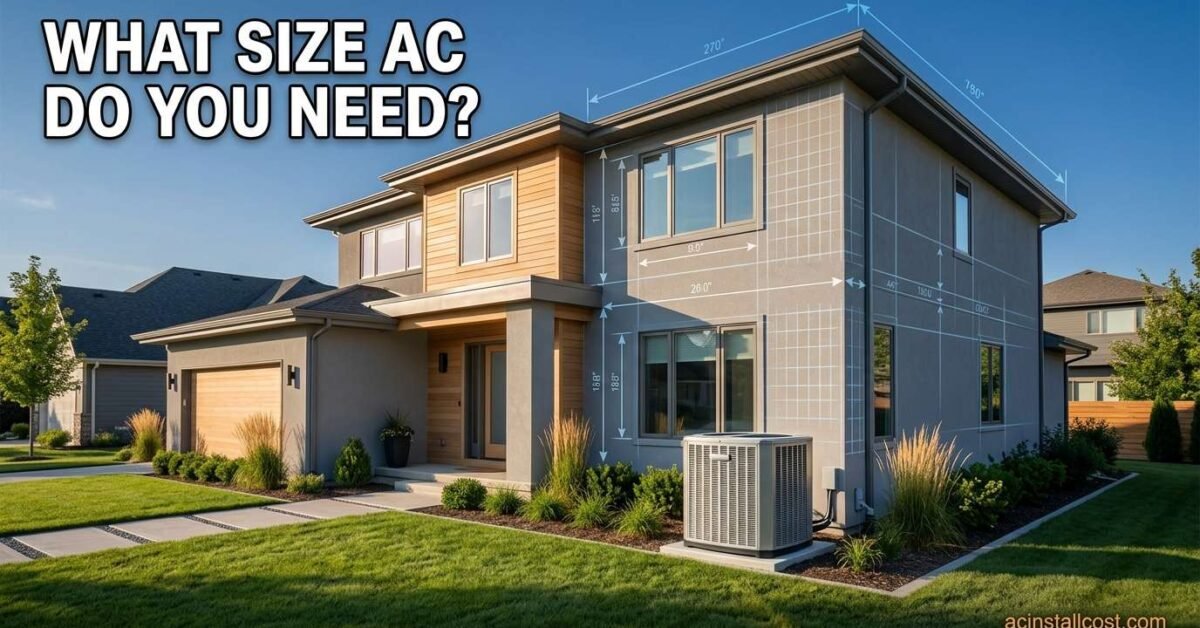
The most common HVAC question homeowners ask is also the one contractors most often get wrong: what size air conditioner do I need? Buy too small and your home never cools; buy too big and you waste money on equipment that short-cycles and leaves the air clammy. This 2026 guide walks through how AC sizing actually works, gives realistic square-footage guidelines, and shows you how to get a fast estimate before you call anyone.
How air conditioner size is measured
Air conditioner capacity is measured in tons, where one ton equals 12,000 BTU per hour of cooling. Residential systems typically run from 1.5 tons up to 5 tons. The goal of sizing is to match the system’s capacity to your home’s cooling load, which is the amount of heat your house gains on a hot day.
A quick way to get in the ballpark is the square-footage rule: most homes need roughly one ton of cooling per 400 to 600 square feet. A 1,600 square foot home, for example, often lands around 3 tons. But that range is wide for a reason, and treating it as gospel is exactly how homes get mis-sized.
Square footage is only the starting point
Two identical 2,000 square foot homes can need very different systems. Climate zone is the biggest variable: a home in Phoenix has a far higher cooling load than the same home in Seattle. Insulation quality, window area and orientation, ceiling height, sun exposure, and how airtight the house is all move the number. That is why a proper calculation, called a Manual J load calculation, accounts for all of these factors rather than square footage alone.
You can get a climate-adjusted estimate in under a minute with our AC tonnage calculator, or run the full five-step HVAC sizing wizard to factor in insulation, windows, and system type.
Rough sizing by square footage
As a planning starting point in a moderate climate, homes near 600 to 1,000 square feet often need about 1.5 tons; 1,000 to 1,500 square feet around 2 to 2.5 tons; 1,500 to 2,000 square feet around 3 tons; 2,000 to 2,500 square feet around 3.5 to 4 tons; and 2,500 to 3,300 square feet around 4 to 5 tons. Hot, sunny climates push these figures up; mild or well-insulated homes pull them down. Always confirm with a load calculation before buying.
Why bigger is not better
It is tempting to round up “just to be safe,” but an oversized air conditioner cools the air so fast that it shuts off before it can pull humidity out of the house. The result is a cold, damp home, more wear from frequent on-off cycling, and higher energy bills. Right-sizing, not upsizing, is what keeps a home comfortable and efficient. The U.S. Department of Energy covers this in its guidance on central air conditioning.
From size to cost
Once you know your tonnage, you can estimate the installed price. Larger systems cost more, and your state’s labor rates and whether you need new ductwork also matter. See a range for your state and size with our AC replacement cost calculator.
What to ask your contractor about sizing
A good installer will not size your system from a chart on a clipboard. Before you sign anything, ask the contractor whether they performed a Manual J load calculation and to see the result. It should reflect your home’s specific insulation, window area, orientation, air sealing, and local design temperature, not just its footprint. If two bids come back a full ton apart, that difference is worth questioning, because one of them is likely wrong. A right-sized quote protects both your comfort and your budget.
Signs your current system is the wrong size
Your existing equipment can tell you a lot. If the house cools quickly but stays humid and clammy, the old unit is probably oversized. If it runs almost constantly and still cannot keep up on the hottest days, it may be undersized, or the home may have gained load from lost insulation or added square footage. Rooms that are always too warm or too cold can also point to a duct or zoning problem rather than raw capacity. Note these patterns before you replace, so you correct the real issue instead of repeating it. When you are ready, the sizing wizard gives you a defensible starting number to compare against any bid.
Frequently asked questions
What size AC do I need for a 2,000 square foot house?
In a moderate climate, a 2,000 square foot home often needs about a 3 to 3.5 ton system, but climate, insulation, and windows shift that. Use a load calculation to confirm.
Is it better to oversize or undersize an AC?
Neither. An oversized unit short-cycles and leaves the home humid, while an undersized one runs constantly and never cools. Right-sizing to a load calculation is best.
How many square feet does a ton of AC cool?
Roughly 400 to 600 square feet per ton in a moderate climate, but hotter climates and poor insulation reduce that figure.
Get real quotes from local HVAC pros
Compare installed prices from licensed contractors near you. Free, no obligation — takes about a minute.